Plenty of communities run perfectly well without a management company. Self-management keeps dues low and decisions local — but it only works when the board has a clear system for the handful of things a manager would normally handle: money, communication, records, and enforcement.
This guide walks through that system step by step, so a volunteer board can run a tight, professional HOA without drowning in spreadsheets.
When self-management makes sense
Self-management is a great fit when:
- Your community is small to mid-sized (roughly 10–250 homes).
- You have at least a couple of reliable volunteers willing to serve on the board.
- Your finances are relatively straightforward — dues in, predictable expenses out.
- You’d rather spend the management fee on reserves and amenities.
If your association is large, in active litigation, or carrying complex commercial obligations, a professional manager may still earn their fee. For everyone else, the four steps below are the whole job.
Step 1: Get the money under control
Dues collection is where most self-managed boards feel the pain first. Chasing checks, reconciling a spreadsheet by hand, and figuring out who’s late is a part-time job nobody volunteered for.
If your board is replacing that process, start with our step-by-step guide to collecting HOA dues online.
A few principles keep it sane:
- Offer online payments and autopay. The single biggest driver of on-time payment is letting residents set it and forget it.
- Automate late notices. Reminders should go out on a schedule without anyone remembering to send them.
- Keep one source of truth. Your ledger, your residents, and your payment records should live in one place — not three.
A board that collects 95% of dues on time without manual chasing has effectively bought back a weekend every month.
This is exactly what Communitrak’s payment tools are built to do — collect dues online, run autopay, and reconcile automatically — but the principle holds no matter what you use.
Step 2: Centralize communication
The second-biggest time sink is communication sprawl: a group text here, a Facebook group there, a stack of printed notices for the folks who aren’t online. Important messages get lost, and “I never got the notice” becomes a recurring dispute.
Pick one official channel and route everything through it:
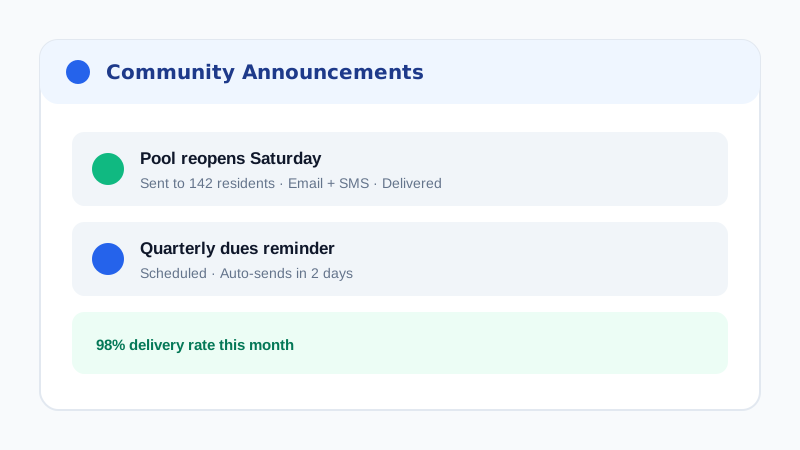
- Mass email and SMS for announcements and reminders
- A community bulletin board for non-urgent posts
- Delivery tracking so you can prove a notice was sent
When communication is centralized, you also get an audit trail — which matters the moment an enforcement decision is questioned.
Step 3: Keep records like you’ll be audited
You may not be, but governing your community as if you will is what separates a credible board from a chaotic one. Keep, in a place the whole board can access:
| Record | Why it matters |
|---|---|
| Governing documents (CC&Rs, bylaws) | The basis for every decision you make |
| Meeting minutes | The legal record of board actions |
| Financials & reserve study | Required for transparency and planning |
| Violation history | Consistency is your best legal defense |
| Resident roster & contact info | Everything else depends on it |
The goal is simple: any board member should be able to find any document in under a minute, and that history should survive turnover when this year’s volunteers hand off to next year’s.
Step 4: Enforce rules consistently
Inconsistent enforcement is the fastest way to lose a dispute — and the fastest way to lose neighbors’ goodwill. The fix is process, not personality:
- Log every violation the same way, with photo evidence and a timestamp.
- Send notices from a template so the language is consistent.
- Track each case from first notice to resolution.
We cover the enforcement workflow in depth in our guide to writing an HOA violation letter, including a template you can adapt. For the system around the letters, including what to record and when to re-inspect, see how to track HOA violations as a self-managed board.
If you want this handled end to end, our violation tracking software logs infractions, sends notices, and keeps the full history automatically.
Putting it together
Self-management isn’t about doing more work than a management company — it’s about having the same systems they’d use, sized for a volunteer board:
- Online dues collection with automated reminders
- One central communication channel with delivery records
- Organized, accessible records that survive board turnover
- Consistent, documented rule enforcement
Get those four right and the management fee stays in your reserves where it belongs. Communitrak bundles all four into one platform built specifically for self-managed HOAs — but whatever tools you choose, the system is what makes self-management work.
Run it yourselves, without the spreadsheets.
Dues, documents, violations, messaging, and your community website in one place, built and priced for self-managed HOA boards.
Have questions first?
Leave your email and we'll be happy to answer any questions.
30-day free trial. No credit card required, no commitment.